

The Two Speed US Economy 2026
by Tejvan Pettinger 5 June 2026

The Two Speed US Economy 2026
It was the best of times, it was the worst of times. If may sound like a cliché, but it is exactly what is happening in the US economy. On the one hand, the stock market wealth is soaring, but at the same consumer sentiment is plunging to record low levels. US Households are putting more than ever into the stock market and this is encouraging a boom in share prices.

But, at the same time credit card delinquency rates have risen, and many households struggle to make ends meet. This shortage of disposable income has seen the US saving rate fall to just 2.6%.

A rate reminiscent of the pre-crash bubble around 2005. The US economy is increasingly reliant on spending of the top 1% and top 10%. How can we explain this divergence in fortunes and how sustainable is the current US economy?

Corporate profitability has increased in recent years, and the recent boom in the stock market has been helped by earnings exceeding expectations.

Yet at the same time households are seeing real wages squeezed by higher inflation. And the recent rises in oil prices exacerbate this trend. Higher gas prices reduce disposable income for workers but increase the profit of fossil fuel economies. But, this is not just about short-term trends, in the past few decades, the US economy has seen a rise in real GDP, far faster than median wages. What is happening is that the worker share of GDP is falling. The gains in productivity are not reflected in higher wages. This is due to the rise of big tech monopolies, greater monopoly power, a less progressive tax system and decline in bargaining power of workers. And this fall in labour income is actually worse for median earners. In 1974, the top 50% had 22% of national income. But, by 2024, this has almost reversed. The top 1% gain nearly twice as much as the top 50%.
It is not just stocks and income. Rising house prices have made homeowners wealthier than ever, but younger households are increasingly locked out of home ownership. House prices remain near record multiples of income, creating a divide between those who already own assets and those trying to acquire them.
AI Investment
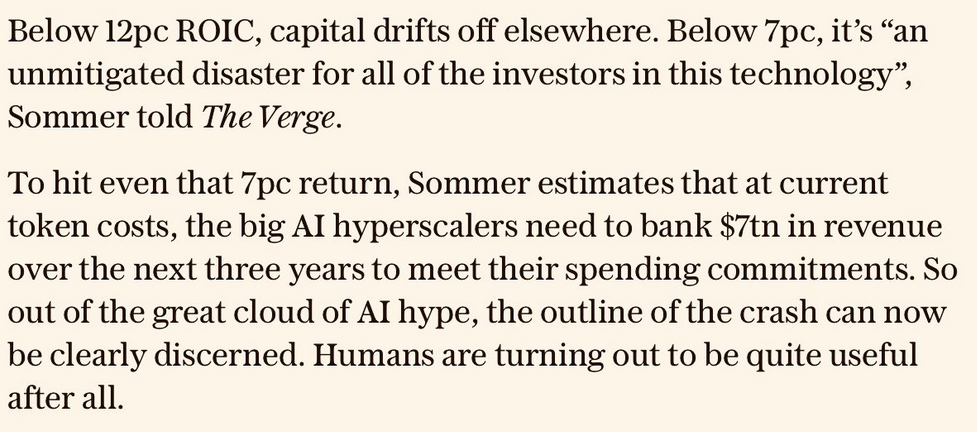
One of the great strengths of the current economy is the AI investment boom. The US is spending more on building data centres than it is on public transport. There is growing doubt about whether AI infrastructure will generate sufficient revenues to cover the current investment. The FT reports that only Amazon can expect a positive return on hyper scaling AI investment. Oracle, and Meta look to be seeing negative returns, and this assumes zero costs. The problem is that as Will Sommer an economic forecaster points out the big AI hyperscalers will need $7 trillion in revenue over the next three years. Where’s it going to come from?
As a result of AI boom, many stocks are also looking suspiciously overvalued. The Shiller CAPE index is close to pre-dot com crash levels. It is worth bearing in mind, how long it took for big tech companies to recover from the dot com crash. Cisco, the world’s most valuable company in March 2000 took 25 years to recover.

The problem is that so much of the US economy is linked to the performance of the stock market and if the stock market falls, many households will see negative wealth effects and reduce spending.

The stock market boom has been helped by demographic factors, more older people putting retirement funds in passive mutual funds. But also the stock market has benefitted from generous tax cuts for corporations, which led to greater share buy backs. But, whilst there have been tax cuts, the recent budget also limited Medicaid provision, and as a result of these changes, it is expected to see a sharp rise in the number of uninsured Americans. This is a major cost setback and explains some of the sharp fall in consumer sentiment we have seen recently. The other problem for the US economy, is the sharp rise in the budget deficit, even though the economic cycle is a period of strong growth. This is very unusual, Normally governments run huge deficits during recessions. Yet America is borrowing at recession-like levels despite low unemployment and continuing growth. Economic growth is being supported by unprecedented fiscal expansion. Not only is the deficit expanding, but demographic factors, will cause real pressures on government spending and borrowing in the future.

The problem is that with rising bond yields, the debt is becoming more expensive to finance, the biggest growth in US government spending is on debt interest payments. Economic growth has definitely been encouraged by fiscal expansion. However, you can’t keep relying on expanding the deficit to boost economic growth, especially with big foreign investors become less willing to hold US bonds.
The irony is that the US economy does have strengths; economic growth has exceeded the Eurozone in the past 5 years. And the economist recently pointed out the conflicting forces in the US economy. Higher tariffs, lower immigration and greater uncertainty have all slowed down growth, but at the same time, increased productivity and higher investment in AI, have maintained quite respectable growth figures. But, whilst President Trump would like to see interest rate cuts to boost growth, an uptick in inflation is actually putting pressure on rate increases.
The US economy isn’t collapsing. In many ways, it remains the world’s most dynamic economy. Growth has outperformed Europe, investment remains strong and American firms continue to dominate global technology.
But beneath the headline numbers lies a growing divide. Stock market wealth is soaring, yet consumer sentiment is abysmal. Corporate profits are rising, yet many households are running down savings. Asset owners have enjoyed enormous gains, while housing and healthcare remain increasingly unaffordable for many Americans.
Related
https://substack.com/home/post/p-199563577
https://www.economist.com/finance-and-economics/2026/05/18/how-much-is-donald-trump-costing-americas-economy
https://www.ft.com/content/32bf8935-8d21-4689-ae34-8b4d3d5f6d93?syn-25a6b1a6=1
https://fortune.com/2026/02/11/national-debt-interest-payments-2-trillion-per-year-by-2036-cbo/
About The Author
